



From Administrative Bottlenecks to Faster Care – How AI-Powered Automation Is Transforming Healthcare Efficiency
Care delays, administrative complexity, and fragmented data continue to challenge healthcare organizations across the United States. These operational inefficiencies increase costs, strain providers, frustrate members, and slow the delivery of care.
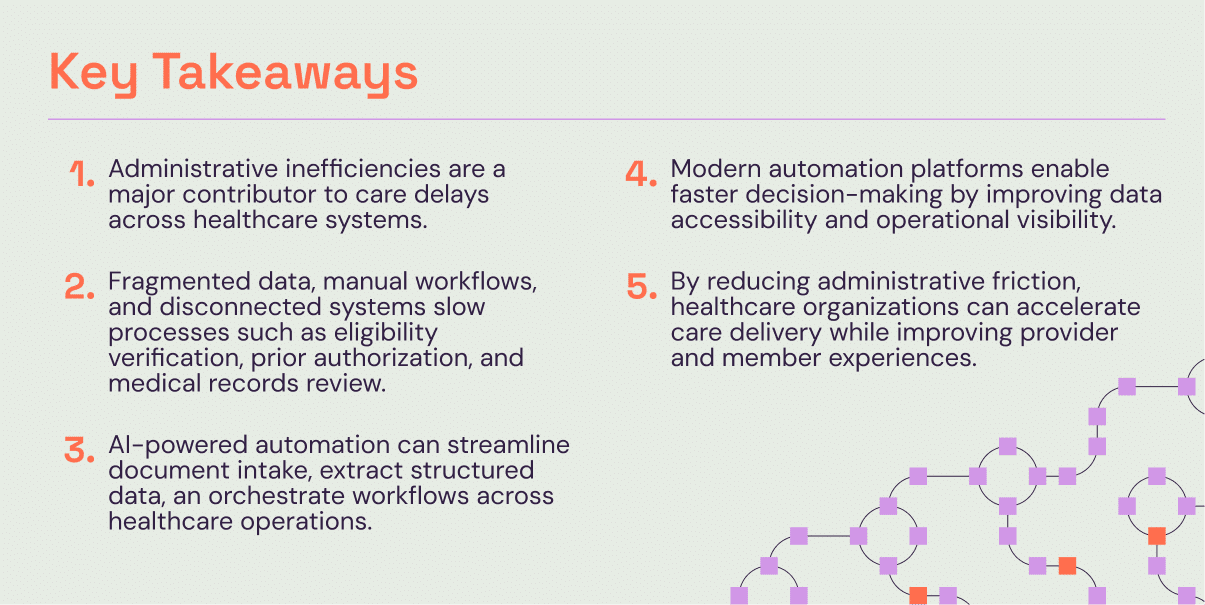
Many of these problems are not clinical. They originate in administrative workflows such as eligibility verification, prior authorization, medical record intake, and claims processing. When these processes rely on manual steps or disconnected systems, critical information moves slowly across the healthcare ecosystem.
The result is a cascading effect: delayed decisions, administrative backlog, provider abrasion, and ultimately slower access to care.
AI-powered automation is emerging as one of the most effective ways to address these challenges. By improving how healthcare organizations capture, structure, and process operational data, automation can remove friction from critical workflows and accelerate the path from intake to treatment.
The Link Between Care Delays and Operational Inefficiency
Long wait times for specialty care remain a major concern across healthcare systems. According to research from AMN Healthcare, average wait times for new patient appointments in many specialties range from 30 to more than 60 days depending on demand and location.
Operational inefficiencies contribute significantly to these delays. Healthcare professionals frequently struggle with fragmented, incomplete, or inaccessible clinical and administrative data. The Philips Future Health Index reports that poor data accessibility and inconsistent data quality slow clinical workflows and hinder timely decision-making.
These issues are closely connected. When data is difficult to access and processes require manual intervention, healthcare workflows become slower and more error-prone.
- Eligibility verification and benefits validation
- Prior authorization and utilization management
- Medical records intake and review
- Claims intake and adjudication support
Disconnected workflows introduce rework, delays, and increased operational burden. In many cases, clinicians and care teams spend valuable time searching for information rather than focusing on care coordination or patient engagement.
Why AI-Powered Automation Matters
Healthcare organizations are increasingly turning to AI and automation to address these administrative constraints.
Modern automation technologies can significantly accelerate operational workflows by capturing information from documents, extracting relevant data, validating inputs, and routing cases to the appropriate systems or teams. When implemented effectively, these solutions reduce manual data entry and improve accuracy across high-volume administrative functions.
Industry benchmarks show strong momentum in this area.
- AI adoption in healthcare continues to grow as organizations report measurable efficiency gains and operational improvements from AI initiatives.
- AI-enabled document intelligence can achieve accuracy rates exceeding 99% when extracting and structuring data from healthcare documents.
Automation does more than simply replace manual work. It enables healthcare organizations to orchestrate information across systems, ensuring that the right data reaches the right teams at the right time.
This capability is especially important in complex payer environments where documents, clinical data, and administrative workflows intersect across multiple operational systems.
Why a Unified Automation Architecture Matters
Many healthcare organizations have attempted to improve operational efficiency by implementing multiple point solutions. While these tools may address individual tasks, they often introduce additional complexity by fragmenting workflows across different platforms.
Staff are then forced to navigate multiple systems, reconcile data manually, and manage exceptions across disconnected tools.
A unified automation architecture can fundamentally change this dynamic by combining AI-powered document intelligence with workflow orchestration and system integration.
When implemented correctly, such an approach can:
- Accelerate data exchange across healthcare stakeholders
- Eliminate redundant manual work
- Improve operational visibility into workflow bottlenecks
- Enable faster, evidence-based operational and clinical decisions
True transformation requires more than basic interoperability. Healthcare organizations need intelligent workflows that normalize, validate, and structure data as it moves through the ecosystem.
When workflows operate on trusted, structured information, organizations can significantly reduce the time between intake, decision-making, and care delivery.
From Operational Efficiency to Better Care Outcomes
By reducing operational friction, healthcare teams gain more time to focus on higher-value activities such as coordinating care, engaging patients, and addressing complex clinical scenarios.
Faster access to accurate information supports more timely clinical decisions and enables healthcare organizations to deliver more personalized care pathways.
This improved operational clarity can help prevent avoidable complications, reduce provider frustration, and improve the overall patient and member experience.
Over time, these improvements also contribute to lower long-term healthcare costs by enabling earlier intervention and more efficient care delivery.
Closing the Gap Between Intake and Care
Care delays are not inevitable. In many cases, they are the result of outdated workflows, manual processes, and fragmented systems.
Healthcare organizations that adopt AI-powered automation can reduce administrative burden, improve data accessibility, and accelerate the movement of information across the healthcare ecosystem.
As the industry continues to evolve, automation and intelligent workflow orchestration are becoming foundational capabilities for healthcare organizations seeking to deliver faster, more connected, and higher-quality care.
The future of healthcare efficiency will not be defined only by clinical innovation, but by how intelligently healthcare organizations manage the operational workflows that support care delivery.
Where could AI-driven automation help your organization remove operational friction and accelerate care delivery?
Frequently Asked Questions
What causes care delays in healthcare operations?
Care delays are often caused by operational inefficiencies rather than clinical capacity. Manual document intake, fragmented systems, incomplete data, and disconnected administrative workflows can slow processes such as eligibility verification, prior authorization, and medical records review. When information is difficult to access or requires manual processing, decisions take longer and administrative workloads increase. Modern healthcare organizations are addressing these challenges by using AI-powered automation to streamline data intake, improve workflow orchestration, and accelerate operational decision-making.
How can AI-powered automation reduce care delays?
AI-powered automation reduces care delays by accelerating administrative processes that occur before care delivery. Technologies such as document intelligence, automated data extraction, and workflow orchestration can process large volumes of healthcare documents quickly and accurately. This enables faster eligibility checks, quicker prior authorization decisions, and improved access to clinical information. By removing manual bottlenecks and improving data accessibility, healthcare organizations can significantly shorten the time between intake, decision-making, and treatment.
Which healthcare workflows benefit most from automation?
Several high-volume administrative workflows benefit significantly from automation. These include prior authorization intake and triage, medical records processing, claims intake and validation, eligibility verification, and provider data management. Automating these processes reduces manual data entry, improves accuracy, and ensures information moves efficiently across systems. For healthcare payers and health plans, automation helps reduce operational costs while improving decision speed and operational transparency.
Why is structured data important for healthcare automation?
Structured data is essential for effective healthcare automation because it allows information to move seamlessly across systems and workflows. When healthcare documents and records are converted into structured, validated data, organizations can automate routing, decision support, and analytics more effectively. Structured data also improves interoperability between healthcare systems, enabling faster operational workflows and better insights for clinical and administrative teams.
How does automation improve efficiency for healthcare payers?
Healthcare payers manage complex administrative processes involving large volumes of documents and data. Automation improves efficiency by capturing and structuring information from multiple sources—such as faxes, emails, portals, and scanned documents—and routing it to the appropriate workflows. This reduces manual effort, improves data accuracy, and accelerates processes such as prior authorization review, claims validation, and member service operations. As a result, payers can improve operational performance while enhancing provider and member experiences.